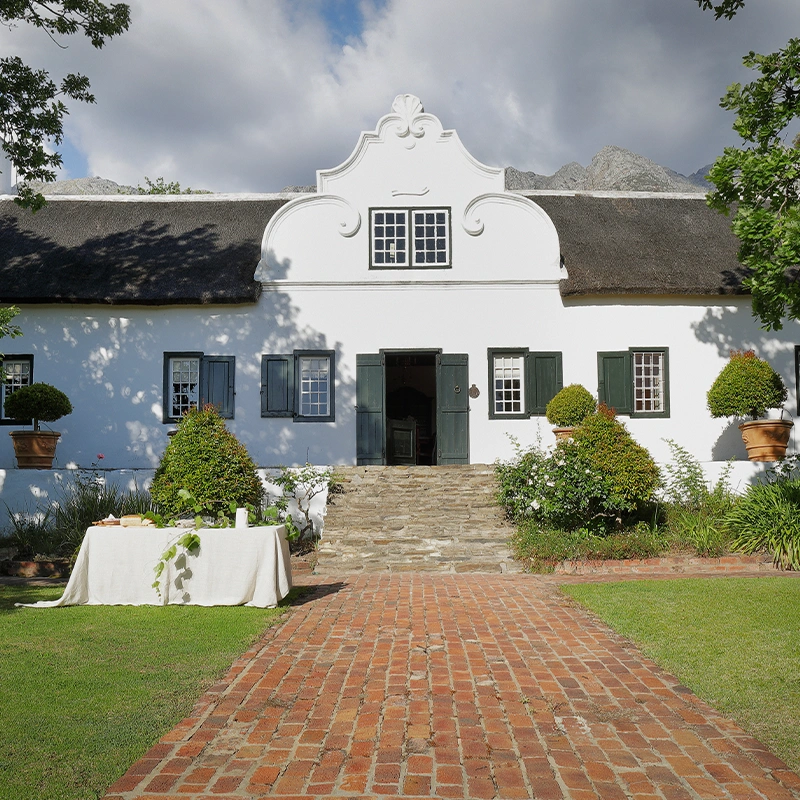
There’s a timelessness in these thick old walls. The echo of generations past lives on in the hush of these rooms with their wide, beeswax-scented yellowwood floorboards, deep window sills and whitewashed walls. While the world has changed, here things hold their own. The H-shaped Cape Dutch homestead, built to last in 1792, oversees life on the beautiful Tulbagh estate.
We’re not the first to appreciate the heritage of Schalkenbosch, a listed national monument. Even the beautiful yellowwood-and-stinkwood built-in katelkassie (wall cupboard) is recorded in the Digest of South African Architecture.
An old Cape soul
There’s something reassuring about the generous proportions of an old Cape farmhouse. At Schalkenbosch, the traditional H-shaped design creates sheltered courtyards at the front and back of the homestead, with a water feature adding to the quiet of the garden. Beyond the whitewashed walls, mature oak trees cast their shade over the lawns, where an old slave bell stands as a reminder of the farm’s layered history. Behind the homestead, the Witzenberg mountains rise dramatically, their craggy peaks occasionally dusted with snow in winter.
The thatched homestead has three en-suite double bedrooms, a gracious voorkamer (front room), separate living and family rooms, an office and a large farmhouse kitchen. Original yellowwood floors and ceilings, three fireplaces and beautifully preserved architectural details give the house its character. There’s a swimming pool for long summer afternoons, extensive stoeps and a generous thatched outdoor entertainment area.
The original farm buildings still form part of the historic werf, lending the estate a sense of continuity that’s increasingly difficult to find. Even the former melkkamer, where milk was once stored and processed, has found a new purpose as guest accommodation.
A life among vines
Schalkenbosch is very much a working farm. Set across approximately 194 hectares on the outskirts of Tulbagh, it has established vineyards, a fully equipped winery and an agricultural heritage stretching back more than two centuries.
Approximately 29,66 hectares are planted to vines, with around 26 hectares currently in production. Cabernet sauvignon, shiraz and merlot feature prominently, alongside grenache, cabernet franc, malbec, viognier, chardonnay and sauvignon blanc, among others. The trellised vineyards are drip-irrigated, with an anticipated harvest of 90 to 120 tonnes.
Although the farm dates to 1792, Schalkenbosch only began bottling wine under its own label in 2002. Today, its wines are produced in the estate’s 600m2 cellar, with capacity for 150 tonnes, and marketed under the Schalkenbosch and Edenhof labels. The established business offers an incoming owner the opportunity to continue a working wine enterprise with its infrastructure already in place.
Water is an important part of the picture, too. The property has registered water rights, dams, boreholes and reservoirs, while a backup generator supports the farming and hospitality operations.
Room for guests
Hospitality has become another chapter in Schalkenbosch’s story. The original outbuildings have been adapted into characterful guest accommodation, retaining their simple country charm rather than attempting to disguise their age.
The accommodation includes Ouma’s Cottage, two further self-catering cottages and a separate thatched guesthouse complex. Together they offer considerable flexibility for visiting family, friends or paying guests. The cottages have their own kitchens and living spaces, with fireplaces for chilly Tulbagh evenings. The larger guesthouse has three bedrooms, four bathrooms and communal dining and entertaining areas.
Guests can spend their days hiking or mountain biking in the surrounding mountains, visiting neighbouring wine farms or exploring historic Tulbagh, just eight kilometres away. Schalkenbosch has even hosted the legendary Absa Cape Epic, a testament to the extraordinary mountain biking terrain on its doorstep. Back at Schalkenbosch, there are gardens for picnics and those extraordinary mountain views to enjoy.
The wider landscape
Beyond the vineyards, the Witzenberg wilderness gives Schalkenbosch much of its character. Bordering the Witzenberg Nature Reserve, the farm is surrounded by mountain fynbos, where proteas grow and sugarbirds, sunbirds and black eagles are among the birdlife. As a recognised WWF Biodiversity & Wine Champion, Schalkenbosch has a longstanding commitment to sustainable farming and the protection of indigenous habitats.
For a new owner, there’s much to consider beyond the pleasures of living in an historic Cape Dutch homestead. The established wine and hospitality businesses offer a sound foundation, with potential for further low-impact agricultural tourism, subject to the necessary approvals.
And perhaps most appealing of all is the opportunity to care for a beautiful piece of Tulbagh’s agricultural and architectural heritage, while enjoying the very particular pleasures of life on a working wine farm in the Cape Winelands.
Written by Sally Rutherford
What are the property details?
- Farm size: 194.3256ha
- Main Cape Dutch homestead: 380m²
- Built in 1792
- Listed national monument
- 3 double en-suite bedrooms
- Voorkamer, living room & family room
- Dining room & farmhouse kitchen with scullery
- Study/home office
- 3 wood-burning fireplaces
- Original yellowwood floors & ceilings
- Swimming pool (currently undergoing repairs)
- Stoeps & thatched outdoor entertainment are
- Guesthouse complex: 180m²
- 3 bedrooms
- 4 bathrooms
- Kitchen, dining room, bar/lounge & indoor braai
- Ouma’s Cottage: 50m²
- 1 double bedroom
- Bathroom
- Lounge with fireplace
- Kitchen
- 2 self-catering guest cottages: 166m² combined
- Cottage 1: 2 interleading double bedrooms, full bathroom, lounge/dining area with fireplace & open-plan kitchen
- Cottage 2: 1 double bedroom, full bathroom, lounge/dining area with fireplace & open-plan kitchen
- Vineyards: 29.66ha planted, approx. 26ha in production
- Trellised & drip-irrigated
- Anticipated harvest of 90-120 tonnes
- Winery: 600m² cellar with 150-tonne capacity
- Wine labels: Schalkenbosch & Edenhof
- Water: Registered water rights, 3 dams, 2 reservoirs & 2 boreholes (not in use)
- Additional infrastructure: Workshop, storage facilities & backup generator